The Front Desk Bottleneck Growing Salons in Singapore Often Face
Jul 06 2026
Key Takeaway
The right salon software in Singapore helps growing salons break through the front desk bottleneck before it stalls expansion.
When the front desk is overloaded, the client experience suffers even if the service quality hasn’t changed.
Phone-based booking, manual scheduling, and paper records create invisible friction that costs real revenue.
Automated appointment management and digital client records free your team to focus on in-person service quality.
Salons that reduce front desk dependency grow faster and retain staff longer.
Introduction
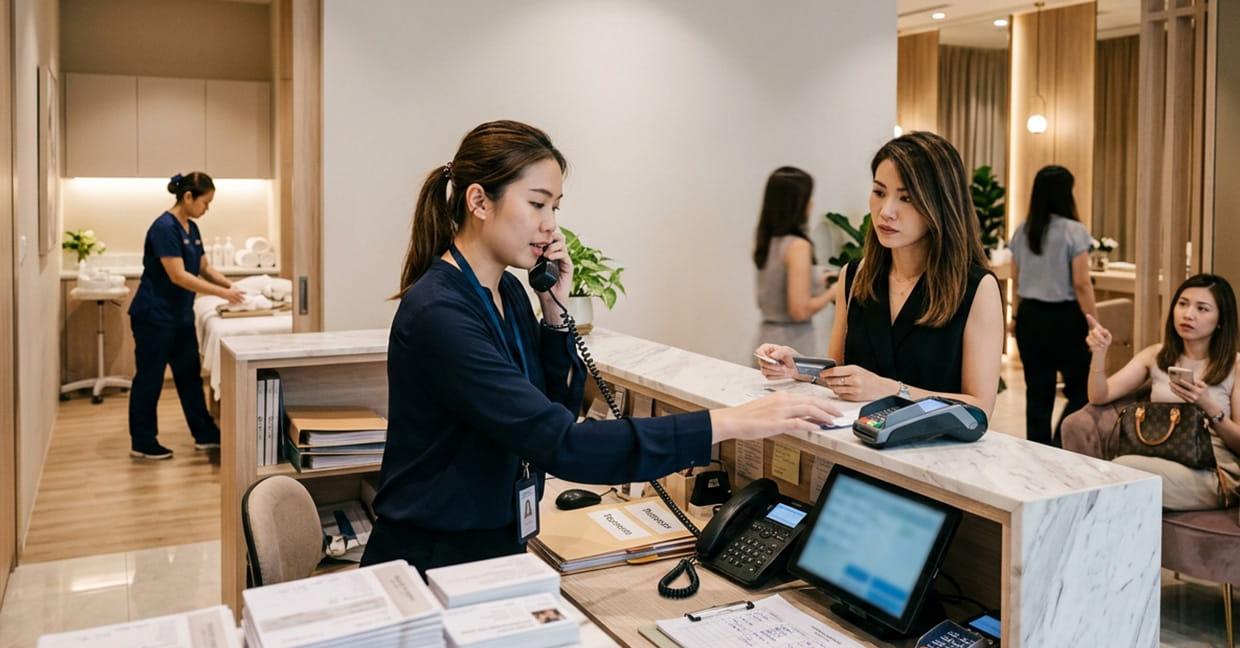
A salon hits its stride. Chairs are full most afternoons, the client list keeps growing, and the stylists are doing their best work. Then something breaks. Calls go unanswered during busy hours. Double bookings start appearing. A staff member spends the first hour of every shift chasing confirmations manually. The service hasn’t changed. The team hasn’t changed. But the front desk has become the ceiling.This is the front desk bottleneck. It’s one of the most common growth barriers Singapore salons face. It doesn’t announce itself. It creeps in gradually as client volume grows and administration quietly outpaces what two people can manage. A client rings during peak hour, gets no answer, and books somewhere else. A walk-in asks about her package balance and waits four minutes while the front desk checks a spreadsheet. A reminder call that was supposed to go out Tuesday gets skipped, and the Friday slot goes empty.None of these are catastrophic in isolation. Together, they represent a pattern that stalls growth. The right platform addresses this directly. Not by replacing your team, but by removing the tasks that slow everyone down. Your front desk can then focus on what actually matters when a client walks in.
What Is Salon Software in Singapore?
Salon software in Singapore refers to management platforms built for salons, spas, and beauty businesses in Singapore. A full-featured system handles appointment scheduling, client records, staff management, package tracking, and payment processing in one place. The strongest platforms also automate routine communication tasks. Booking confirmations, reminders, and follow-ups run without manual effort. This reduces front desk workload without removing staff from the process.
Why the Front Desk Becomes a Bottleneck
The front desk in a growing salon wears many hats. It handles incoming calls, confirms appointments, greets walk-ins, processes payments, and manages package balances. It updates client records and often handles social media messages too. When client volume is low, one person can cover all of this. When it grows, the same person can’t.The problem compounds because most of the tasks that pile up are administrative, not relational. Chasing a confirmation call, re-entering a booking after a miscommunication, or manually calculating a package balance aren’t high-value activities. They fill the day with friction. Every minute spent on them is time not spent with a client. Welcoming someone at the door, explaining a treatment, turning a first-timer into a regular.Salons often try to solve this by hiring another front desk staff member. That helps temporarily, but it doesn’t fix the underlying issue. Two people doing the same manual processes will hit the same wall at a higher volume. The real fix is reducing how much manual work the front desk needs to do in the first place.There’s also a cost consideration. A front desk hire in Singapore comes with salary, CPF contributions (Singapore’s mandatory pension scheme), and onboarding time. If that role is mostly administrative, you’re paying staff to do work a system could handle. That’s an expensive way to manage a fixable problem. The better allocation is a platform that handles those tasks while your team focuses on clients.“The front desk bottleneck doesn’t stop your salon from being busy. It stops it from growing.”Research across the beauty and wellness sector shows just how real this pressure is. A Zenoti survey found that45% of beauty and wellness clients named wait times as their top frustration in 2024. More than half said they’d hang up after three minutes on hold. For a front desk already stretched thin, a brief rush period can mean missed calls that never return.
The Four Gaps Driving the Bottleneck
Booking Happens Only During Business Hours
When your only booking channel is the phone, your clients can only book when someone’s available to answer. That’s a narrower window than most salon owners realise. The same Zenoti research shows 81% of salon clients need to manage bookings outside business hours at some point. Many won’t call back if they hit voicemail.A salon POS with integrated online booking opens the window around the clock. A client who decides at 10 pm that she wants a colour appointment on Saturday can confirm it immediately, without waiting. By the morning, the slot is filled and confirmed without your team having lifted a finger. For salons close to full capacity during peak hours, this after-hours channel captures bookings that would otherwise be lost.
Manual Scheduling Creates Errors Under Pressure
Three stylists, a walk-in, and a rescheduling request all landing at once on a busy Saturday will break manual scheduling. It always does. The question is how often. Manual calendar management doesn’t break down in theory. It breaks down in the moment, under load, with no time to double-check.A salon POS with real-time availability management prevents this. Every booking updates the calendar the moment it’s confirmed. That applies whether it came from an online form, a phone call, or a walk-in. Your team sees one source of truth at all times. The client arriving for a 2 pm appointment won’t discover her slot was given to someone else.
Client Records Live in Different Places
Service history in a notebook, package balance in a spreadsheet, contact details in a chat thread. Getting to any of it takes effort. That adds up across every single client interaction. If the person who knows that the client is away is the next team member starts from scratch.A platform that centralises all client data removes this entirely. Service history, package balances, product preferences, and contact details are accessible by any team member in seconds. The result is a more consistent experience for the client and a faster handoff between staff. Clients notice when a new team member knows their preferences without being told.
Reminders and Follow-Ups Depend on Memory
Reminder calls are time-consuming and easy to skip on a busy day. When they don’t go out, no-shows increase. When they do go out, the staff member making them isn’t doing anything else. Neither is a good use of your front desk’s time.Automated reminders handle this without any manual effort. The system sends a confirmation at the point of booking and a reminder before the appointment. If a client needs to reschedule, she can do it through the same message. Your team doesn’t have to make a single reminder call. That time goes back to in-person client interactions.
Commission Calculations Are Done Manually at Month End
This one often gets overlooked, but it’s where a lot of front desk and management time quietly disappears. Calculating commission for multiple stylists across different service types, package redemptions, and upsells by hand takes hours. It’s also prone to errors that create friction with staff.A beauty salon system with built-in commission tracking automates this entirely. Each service is attributed to the right staff member at the point of sale. The report is ready without anyone manually cross-referencing a log. That removes a task that would otherwise take a senior staff member half a day at every pay cycle.
What Changes When the Bottleneck Clears
When front desk tasks run on automation rather than manual effort, two things change. First, your existing staff can do their jobs better. They’re not constantly switching between a call, a booking, and a payment. They focus on the client in front of them. That directly affects service quality and the likelihood of a return visit. Second, your salon can absorb more clients without immediately hiring another person to manage the paperwork.This is where the right platform creates measurable value. Studio Manager automates appointment confirmations, reminder messages, staff commission tracking, and package balance reporting from a single dashboard. Your front desk team sees every appointment and every client record without switching between systems.“Reducing front desk manual work doesn’t change the service. It changes how much service the same team can deliver.”Studio Manager’sbeauty software also supports multi-branch operations. When each branch runs on the same system, the owner gets visibility across the whole business without visiting each site. Revenue, occupancy, staff performance, and package redemption rates appear in one report. For salons at two or more locations, that kind of consolidated view becomes increasingly hard to maintain through manual methods.There’s also a staff retention benefit that’s easy to overlook. Front desk work that is genuinely overwhelming drives turnover. When the system handles the repetitive tasks, the job becomes more manageable. Staff give proper attention to clients, which is why most of them chose the role. The work itself becomes more rewarding. Salons that reduce administrative overload tend to keep front desk staff longer. That matters because experienced front desk staff is hard to replace quickly. Training a replacement takes weeks. The client knowledge a long-serving front desk person carries doesn’t transfer easily to someone new.
Is Salon Software Singapore the Right Move for a Growing Salon?
Peak hour overwhelm, recurring double bookings, and rising no-shows are all signs the bottleneck is already costing you. The question isn’t whether to fix it. It’s whether you fix it before or after the revenue impact becomes visible.Salons that move early tend to grow faster because they’re not spending management energy on front desk problems. They’re spending it on service quality, staff development, and new client acquisition. The reduction in manual work doesn’t just improve efficiency. It changes what your team is free to do. That affects the experience every client has when they walk through the door.Singapore salons face high space and staffing costs. Growing revenue without proportionally growing headcount is a real advantage. The right system is what makes that possible.
Frequently Asked Questions
1. What does salon management software actually do?
It handles appointment scheduling, client records, payment processing, staff management, and automated communication. Any salon with a growing client base and manual front desk processes will see clear benefit from making the switch.
2. How does a salon POS reduce front desk pressure?
A salon POS automates appointment confirmations and sends reminders without manual input. It maintains a real-time booking calendar that prevents double bookings. Front desk staff no longer have to make reminder calls or cross-check schedules by hand. That frees them for client interactions instead of administration. Over time, the reduction in errors also reduces the number of difficult client conversations your team has to manage.
3. Can beauty software help with staff management too?
Yes. A beauty software platform like Studio Manager includes staff commission tracking, biometric attendance, and scheduling tools. Managers can see staff productivity and punctuality from the same dashboard used for client records and booking management. Commission reports are generated automatically at each pay cycle, removing a task that previously consumed hours of manual work.
4. What happens to client data when a front desk staff member leaves?
With a centralised beauty salon system, all client records, preferences, and package balances are stored in the platform. They’re not held in staff members’ notebooks or memory. When someone leaves, the next team member has full access to everything they need to serve that client well.
5. How long does it take to see results after switching to salon software?
Most salons notice an immediate reduction in reminder calls and scheduling errors within the first few weeks. Measurable impacts on no-show rates and staff time savings become visible over one to three months. The speed depends on how much manual work was being done before the switch.Growing a salon in Singapore isn’t just about building a bigger client list. It’s about building the operational foundation to serve that list well. The front desk bottleneck is the most common reason growing salons stop growing. It’s not a staffing problem. It’s a systems problem. The right salon software for Singapore businesses addresses this directly.If your team is spending time on tasks a system should handle, that time is coming from somewhere. Explore howStudio Manager’s salon software can take the manual load off your front desk. You can also read abouthow beauty salon management software builds client retention. And if your sales team is involved in client conversion, seewhy a beauty CRM supports their performance.